



Everyone treats millennials and Gen Z like they’re basically the same — young, chronically online, allergic to buying houses. But spend five minutes in a room with both and you’ll feel the gap. Here’s what’s actually different between the two generations, beyond the stereotypes.
What’s the actual difference between millennials vs Gen Z?
The Pew Research Center defines millennials as anyone born between 1981 and 1996, and Gen Z as anyone born from 1997 to 2012. That gap sounds small. The lived experience is not.
Millennials grew up watching the internet get invented. They made Facebook accounts in high school, got their first iPhones in their 20s, and figured out privacy settings after already oversharing for years. Gen Z got handed an iPad as a toddler. They didn’t discover the internet — they were born into it. Connectivity isn’t something Gen Z adopted. It’s the water they’ve always swum in.
That one difference — witnessing technology’s rise versus being born after it — ripples into almost everything else: how each generation communicates, what they expect from jobs, how they handle mental health, and what they trust.
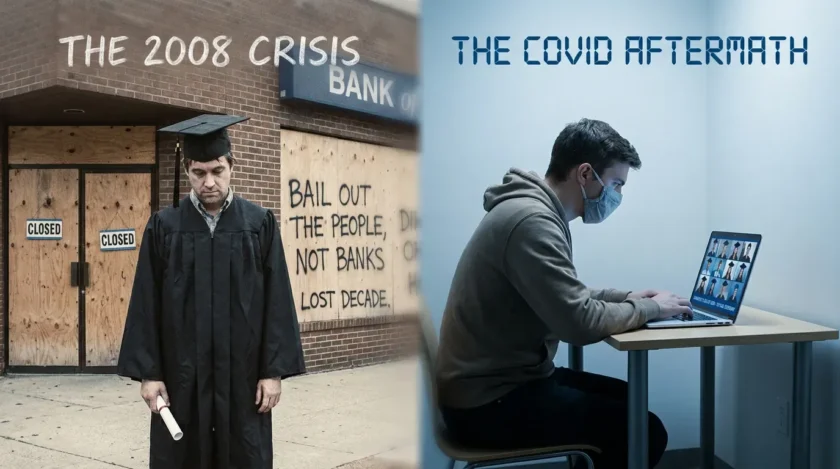
The other big dividing line is the economy they came of age in. Millennials entered adulthood during the 2008 financial crisis, which wrecked their early career years and made them increasingly cynical about institutions. Gen Z came of age during COVID — which hit right as the oldest of them were entering the workforce. Two different financial traumas, two different flavors of distrust.
Dreamers vs. Realists: The Mindset Gap
Millennials are often described as dreamers. Gen Z are being called realists. That’s not a dig at either — it’s a product of who raised them and what they watched happen.
Millennials were encouraged by their Baby Boomer parents to find work they were passionate about. “Do what you love and you’ll never work a day in your life” was the operating philosophy. So millennials job-hopped, chased meaning, and racked up student debt for degrees that felt worth it at the time. Millennials value stability (34%), while Gen Z puts more of an emphasis on finding their dream job (32%). Which sounds backwards until you realize that millennials learned, the hard way, that chasing dreams without a safety net is a liability.
Gen Z watched that happen from the sidelines. They saw older siblings graduate into a recession, drown in loan payments, and move back home. So they came in more pragmatic — more Gen Zers are concerned about the cost of education (21%) compared to millennials (13%), and they’re increasingly skeptical that a four-year degree is automatically worth the price tag.
Seventy-five percent of Gen Z say there are other ways of getting a good education than going to college. That’s not laziness. That’s pattern recognition.
How do millennials and Gen Z use social media differently?
Both generations live online. But they use the internet in completely different ways, and for completely different reasons.
Millennials were the original social media overshares. They built their digital identities on Facebook and early Twitter — real names, real opinions, real drama posted publicly for anyone to find. They were the beta testers of the attention economy, and they paid for it. Employers started Googling candidates. Screenshots lasted forever. Millennials learned about digital permanence the hard way, from experience.
Gen Z came up with the cautionary tales already written. They grew up with the receipts of millennial oversharing as a warning label. So they built different habits: more private accounts, more ephemeral content, more compartmentalized identities. One account for close friends. One for the public. One for a niche interest no one in their real life knows about. The shift from “Dr. Google” with millennials to “Dr. TikTok” with Gen Z captures it neatly — even how each generation researches information is different.
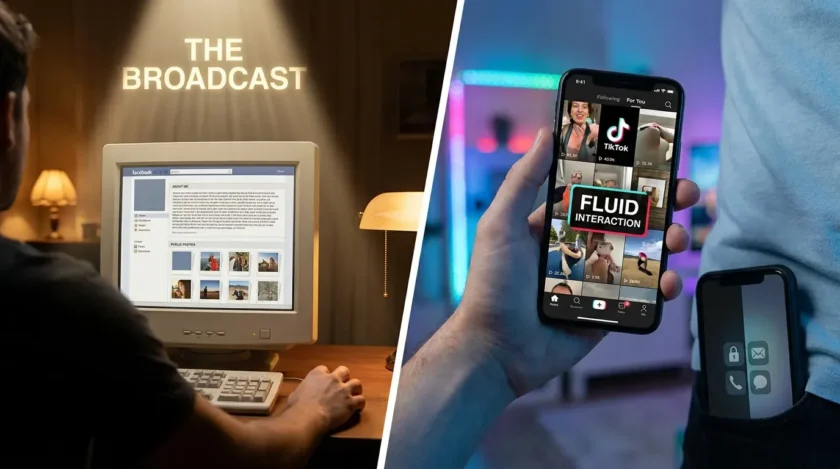
The platform divide also matters. Millennials built their formative internet lives on Facebook, Instagram, and Twitter — visual and text-heavy, designed for broadcast. Gen Z moved to TikTok and YouTube Shorts — video-first, fast, algorithm-driven, where the creator and the consumer are nearly interchangeable. Millennials perform for an audience. Gen Z participates in one.
Are Gen Z and millennials facing the same financial struggles?

Partially yes, but not equally — and the gaps are growing.
Both generations got hit with economic crises at the worst possible time. Both carry student debt. Both have watched housing prices make homeownership feel hypothetical. On paper, they’re in the same boat.
But the boat is leaking faster for Gen Z. Millennials stand to inherit over $68 trillion from Baby Boomer and early Gen X parents by the year 2030, setting them up for a significant wealth transfer that Gen Z won’t see for decades. Meanwhile, Gen Z is entering a labor market shaped by inflation, AI automation anxiety, and in some places, genuinely brutal youth unemployment — in Canada, people aged 15 to 24 faced an unemployment rate of 12.2% as of 2025, more than twice that of prime working-age adults.
The Deloitte Global Gen Z and Millennial Survey, which polled more than 23,000 respondents across both generations, found that both groups want the same basic things from work: money, meaning, and well-being. But the balance they want differs. Only 6% of Gen Z say their primary career goal is to reach a leadership position. That’s not ambition dying — it’s ambition being redirected. Gen Z isn’t trying to climb a ladder that their older peers have already told them leads nowhere satisfying.
What millennials want is flexibility and purpose. What Gen Z wants is support, mental health resources, and the option to leave without guilt. Same general direction, different urgency.
Mental Health: Gen Z Has It Harder

This isn’t really a debate anymore. The data is fairly consistent.
A Gallup and Walton Family Foundation report found less than half of Gen Z individuals (47%) consider themselves “thriving” — the lowest rate among any generation in the U.S., and lower than millennials at the same age. Additionally, 36% of Gen Z rate their mental health as “fair” or “poor,” compared to 27% of millennials.
That gap has a few likely causes. Gen Z grew up with social media already embedded in adolescence — not something they adopted as adults with some emotional scaffolding already in place, but something they were navigating at 12 and 13. The comparison engine was always on. The performance pressure was baked into puberty.
There’s also the pandemic factor. Millennials had their formative social years before COVID. Gen Z had theirs interrupted by it. Some researchers argue that the isolation during peak developmental years did lasting damage to Gen Z’s social confidence and mental health baseline that millennials simply didn’t experience.
None of this means Gen Z is broken. The same generation reporting higher rates of mental health struggles is also more likely to actually seek help, normalize therapy, and talk openly about it — which is, measurably, a form of progress millennials started and Gen Z accelerated.
The Original Take: Gen Z Didn’t Reject Millennial Values — They Pressure-Tested Them
Here’s the angle most millennial vs. Gen Z content misses entirely.
Gen Z didn’t arrive with a completely new value system. They inherited millennial values — diversity, mental health awareness, work-life balance, climate anxiety, skepticism of institutions — and then actually lived through what happens when those values meet real-world systems that weren’t built for them.
Millennials introduced the vocabulary. Gen Z is using it in job interviews, in HR complaints, in voting booths, and on TikTok with 40 million views. Where millennials hoped companies would change, Gen Z assumes they won’t and plans around that assumption. Where millennials fought for representation in the room, Gen Z is increasingly skeptical of whether the room was worth fighting for in the first place.
That’s not nihilism. It’s what realism looks like when it’s been raised on millennial idealism and then handed a post-pandemic economy.
Key Differences at a Glance
- Birth years: Millennials, 1981–1996. Gen Z, 1997–2012. The cutoff matters more than people think — one side remembers 9/11, the other doesn’t.
- Relationship to technology: Millennials adopted the internet. Gen Z was born into it. Different relationship to privacy, permanence, and digital identity.
- Defining economic trauma: Millennials, the 2008 recession. Gen Z, COVID-19 and its aftermath.
- Workplace ambitions: Millennials want purpose and flexibility. Gen Z wants support, mental health resources, and the right to not hustle.
- Social media behavior: Millennials broadcast. Gen Z curates, compartmentalizes, and consumes video-first.
- Mental health: Gen Z reports worse outcomes — but also more openness about seeking help.
- Financial outlook: Both are struggling, but millennials have a massive wealth inheritance coming. Gen Z is on their own longer.
- Worldview: Millennials: optimistic in youth, increasingly disillusioned. Gen Z: pragmatic from the start.
The most honest summary of the whole millennials vs. Gen Z debate is this: millennials tried to change the system from the inside and got tired. Gen Z watched that happen and decided to want different things from the system entirely. Whether that’s growth or surrender probably depends on which side of 1997 you were born on.
Comments are closed.