



Gen Z Jobs availability have a higher unemployment rate than workers with only a high school diploma — the first time that’s happened since the federal government started tracking the data in the 1990s. Gen Z didn’t break the job market. They just got handed the bill.
Why is it so hard for Gen Z to find jobs right now?

The numbers are bleak and they’ve been getting worse since 2022.
The Federal Reserve Bank of New York’s graduate labor market tracker found that unemployment among recent college graduates aged 22–27 climbed to 5.7% in the fourth quarter of 2025 — well above the 4.2% national rate. Underemployment, which measures graduates working in jobs that don’t require a degree, hit 42.5%, its highest level since 2020. In plain terms: nearly half of recent grads who are employed are working jobs that didn’t need the degree they just paid for.
The entry-level pipeline has structurally collapsed. Entry-level job postings have fallen 29 percentage points since January 2024, according to Randstad’s analysis of 126 million global job postings. Finance and information services — the industries that historically absorbed the largest share of new graduates — have been shedding an average of 9,000 jobs per month since 2023. Before the pandemic, those same industries were adding 44,000 jobs per month. White-collar payrolls have now contracted for 29 consecutive months, a streak without precedent in the past 70 to 80 years, according to Aaron Terrazas, former chief economist at Glassdoor.
The share of unemployed Americans who are new workforce entrants hit a 37-year high in July 2025, peaking at 13.3% before settling at 10.6% by February 2026. That figure is still higher than at any point during the Great Recession.
Two compounding forces are making this worse. First: the job market froze rather than crashed. It’s a “low hiring, low firing” economy — companies aren’t hemorrhaging workers, but they’re not bringing new ones in either. When hiring slows, the door closes first on people with no experience. That’s Gen Z. Second: AI is eliminating the starter roles that used to let young workers build skills and prove themselves. Anthropic CEO Dario Amodei warned that AI could soon wipe out half of all entry-level white-collar roles. That future has started arriving early for computer programmers — employment in that field recently dropped to its lowest level since 1980.
None of this is a Gen Z attitude problem. The class of 2025 and 2026 is knocking on doors that have been locked from the inside.
What jobs are Gen Z actually getting hired for?

The honest answer: not the ones most of them trained for. But there are sectors that are genuinely hiring.
Healthcare is the clearest bright spot. Home health, physician, and nursing job postings have seen a combined 162% growth rate since pre-pandemic, according to 2025 data from Indeed. Physician and surgeon roles alone are up 90%. Healthcare is a classic recession-resistant industry — medical care is always in demand, and critically, AI can’t be trained to sterilize surgical equipment or draw blood. The industry is 77.6% female, which partly explains why Gen Z women have maintained better employment outcomes than their male counterparts. In Q2 2025, 9.1% of Gen Z men were unemployed compared to 7.2% of women — a gap that has persisted and widened since the pandemic.
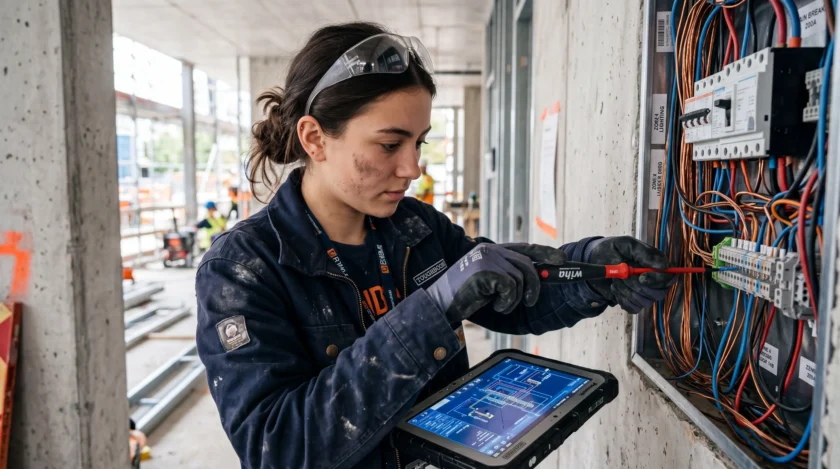
Skilled trades are having a genuine moment. For six months in 2025, workers with an occupational associate’s degree in skilled trades — plumbers, electricians, pipe fitters — posted slightly better employment outcomes than college graduates. According to Forbes, 37% of Gen Z graduates are pursuing or already employed in blue-collar work, attracted by stability, pay, and the fact that these roles are functionally automation-resistant. Some are skipping the degree entirely: companies like Lowe’s have made major investments in skilled trades training programs specifically targeting younger workers who want to bypass the four-year credential treadmill.
Gig, contract, and multi-role work. It’s not a dream scenario, but it’s increasingly the reality. The number of people working multiple jobs hit its highest level in more than a decade, with Gen Z leading the charge. Deputy’s “The Big Shift 2026” report — drawing from more than 41 million shifts and 268 million hours worked — found that poly-employment (working multiple jobs simultaneously) now counts Gen Z as more than half (55%) of all participants.
How is Gen Z adapting to the current job market?

Three ways: with strategy, with frustration, and sometimes by burning the whole playbook.
Poly-employment as a survival move — and increasingly a choice. The Fortune framing on poly-employment is important here: it’s not just economic desperation. Deputy CEO Silvija Martincevic told Fortune that for Gen Z, the shift is “as much cultural as it is economic — a deliberate break from the traditional workforce they watched chain their parents to the golden handcuffs of a 9-to-5 job.” Watching their parents get laid off after decades of loyalty to a single employer taught Gen Z something millennial optimism didn’t: hedging beats betting.
The data splits poly-workers into two groups. Those who hold a full-time role while juggling others tend to be “AI-advantaged” — using automation to manage their schedules and work efficiently across multiple commitments. Those who work exclusively multiple part-time roles without a full-time anchor tend to be more AI-resistant, viewing the technology as a direct threat to the precarious gigs they depend on. Both groups are rational. They’re just positioned differently relative to the same technological shift.
AI in the job search itself. A growing share of Gen Z graduates are using AI during job interviews and applications — not as cheating, but as a competitive response to a market that has already automated large portions of hiring. Hiring projections for the class of 2026 are essentially flat, at 1.6% growth. Candidates submitting dozens of applications receive interview invitations at rates below 2%. The National Association of Colleges and Employers found that 45% of employers characterize the job market for the class of 2026 as “fair” — down from “good” the previous year. When the odds are that bad, using every available tool starts looking less like fraud and more like survival math.
Resistance and sabotage. Not everyone is adapting cooperatively. A study from AI enterprise platform Writer found that 44% of Gen Z workers are intentionally sabotaging their company’s AI rollout. This isn’t random technophobia — it’s workers who correctly understand that the automation being deployed above them is the same automation threatening their roles below. When the technology that’s supposed to make work easier is also the technology eliminating your position, resistance is a rational response, not an irrational one.
The structural shift nobody’s talking about enough

Here’s the angle that most Gen Z jobs coverage misses: the college degree premium isn’t just declining — it has briefly inverted. For the first time since the federal government began tracking this data in the 1990s, recent college graduates are actually more likely to be unemployed than the overall workforce. The Burning Glass Institute documented the closing gap, and the Federal Reserve Bank of New York’s tracker confirmed the crossover in 2025.
By 2034, there could be 7–11 million more college graduates competing for fewer degree-relevant roles, according to workforce projections cited by MyPerfectResume research. The credential that was supposed to be the floor is becoming a liability in sectors that have been gutted by automation and hiring freezes — while skilled trades, healthcare, and flexible multi-role work are the actual employment that’s available.
That doesn’t mean don’t go to college. It means the calculus has changed, and anyone who tells you otherwise is selling something.
What’s actually worth doing if you’re in this job market
- Stop applying to dead categories. Finance and tech entry-level roles are hemorrhaging postings. Healthcare, construction management, skilled trades, and logistics are not. The market is uneven, not uniformly broken.
- Get the Federal Reserve Bank of New York’s graduate labor market tracker bookmarked at newyorkfed.org/research/college-labor-market. It updates quarterly and breaks down unemployment and underemployment by major. It’s the most accurate picture of where you actually stand.
- Consider poly-employment as a deliberate strategy, not a fallback. Two part-time roles in different industries gives you diversified income and a broader network than one entry-level job where you’re the most expendable person in the room.
- Skills-first hiring is genuinely gaining ground. More companies are dropping degree requirements and hiring on demonstrated competency. Certifications, portfolios, and project-based proof of work are outperforming credentials in a growing number of sectors.
- The trades are not a consolation prize. A licensed electrician in 2026 is outearning and outemploying a recent communications grad. That’s not a rhetorical point — it’s what the BLS data actually shows.
Gen Z didn’t create a bad job market. They inherited a combination of post-pandemic overcorrection, aggressive AI adoption at the entry level, and a hiring culture that increasingly demands three years of experience for positions labeled “entry-level.” The Brookings Institution documented how economic uncertainty and tariff-driven cost pressure have made companies reluctant to take on new payroll in its 2026 midterm analysis. The Federal Reserve Bank of New York has been tracking exactly what that means for recent graduates in real time. The data is public. The pattern is clear. The question now is whether anyone with the power to fix it decides to.
Comments are closed.